Press
Douze Points is an unofficial, independent forecast of the Eurovision Song Contest 2027 in Burgas, powered by its own model, Twelve. Everything here is free to quote and embed with credit.
The story in numbers
Each figure comes from the voting database behind the forecast: every jury and public vote since 1957.
For journalists
How to read the numbers
Every figure on Douze Points comes from playing the 2027 semi-finals and final many thousands of times. Here is what each number means, in plain words.
- Chance to win
- The share of simulated contests a country wins. 5% means it wins about 1 contest in 20.
- Chance to reach the final
- The share of simulations in which it qualifies from its semi-final.
- Likely range
- The middle 8 in 10 outcomes. Wide ranges are normal before the songs are known.
- Track record
- Tested on past contests, it named 5 of 9 winners against 4 or 5 for the bookmakers’ favorite.
Download the data
Free to use with the credit “Douze Points by Valev Laube”. Updated with every forecast.
- forecast.csvCurrent forecast, one row per country, with plain column names
- history.csvEvery saved forecast since launch, to chart how chances moved
- forecast.jsonFull forecast, including finishing-place distributions
- countries.jsonEvery past entry and result for each country
How to cite
Douze Points Eurovision 2027 forecast by Valev Laube, model: Twelve (douze.valevlaube.com). Unofficial; based on 10,000 simulated contests.
How sure is it?
Two kinds of uncertainty. Running 10,000 simulations adds a small random wobble, about ±0.4 percentage points on a 5% chance. Much bigger is real-world uncertainty: songs, staging and the night itself. That is why a 5% favorite is far from a certainty, and why the numbers sharpen as the songs arrive.
Story angles
Embed the live board
Paste this into any article. It updates itself as the forecast changes. Pick the top-10 board or a single country's card. For the board, change n= to show more or fewer countries; add &lang=et for Estonian or &lang=fr for French.
Logo and brand kit
The points ladder: ten bars for the ten scores a jury or a public gives, with the twelve lit. Use it as is, on night or on white. Only the twelve is ever gold.









- Night
#140b3c - Bone
#f5f2ff - Lamp
#ffc93c - Amber
#d48a00 - Deep
#1c1250
Twelve, the model
The forecast is made by Twelve, our own model, named after the most points a jury or a public can give. Please credit it as “Forecast by Twelve, the Douze Points model”.
- The one-page explainerWhat it does, what it knows and its track record, with today's top five
- PDF · EnglishPDF · EestiPDF · Français
The whole kit
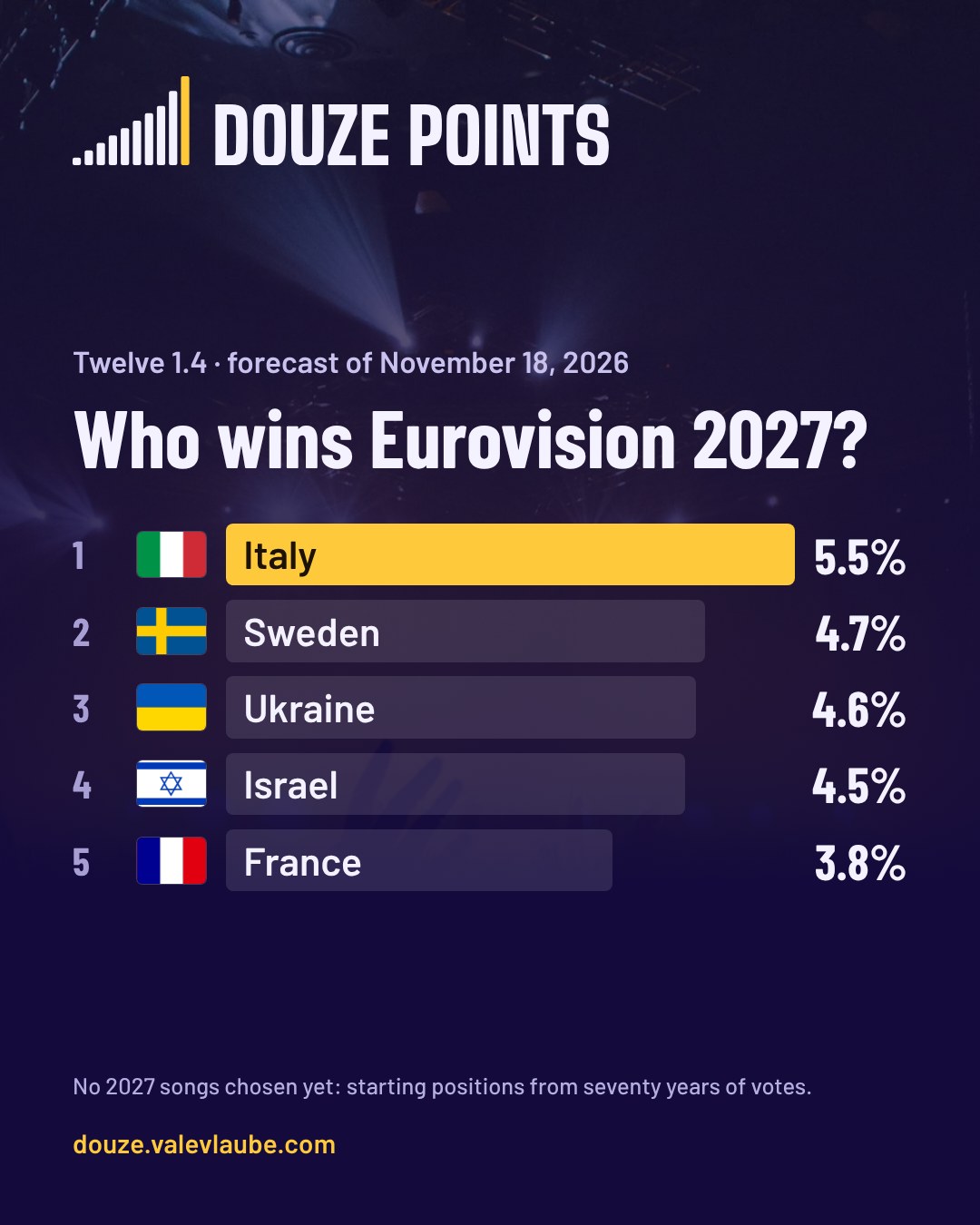
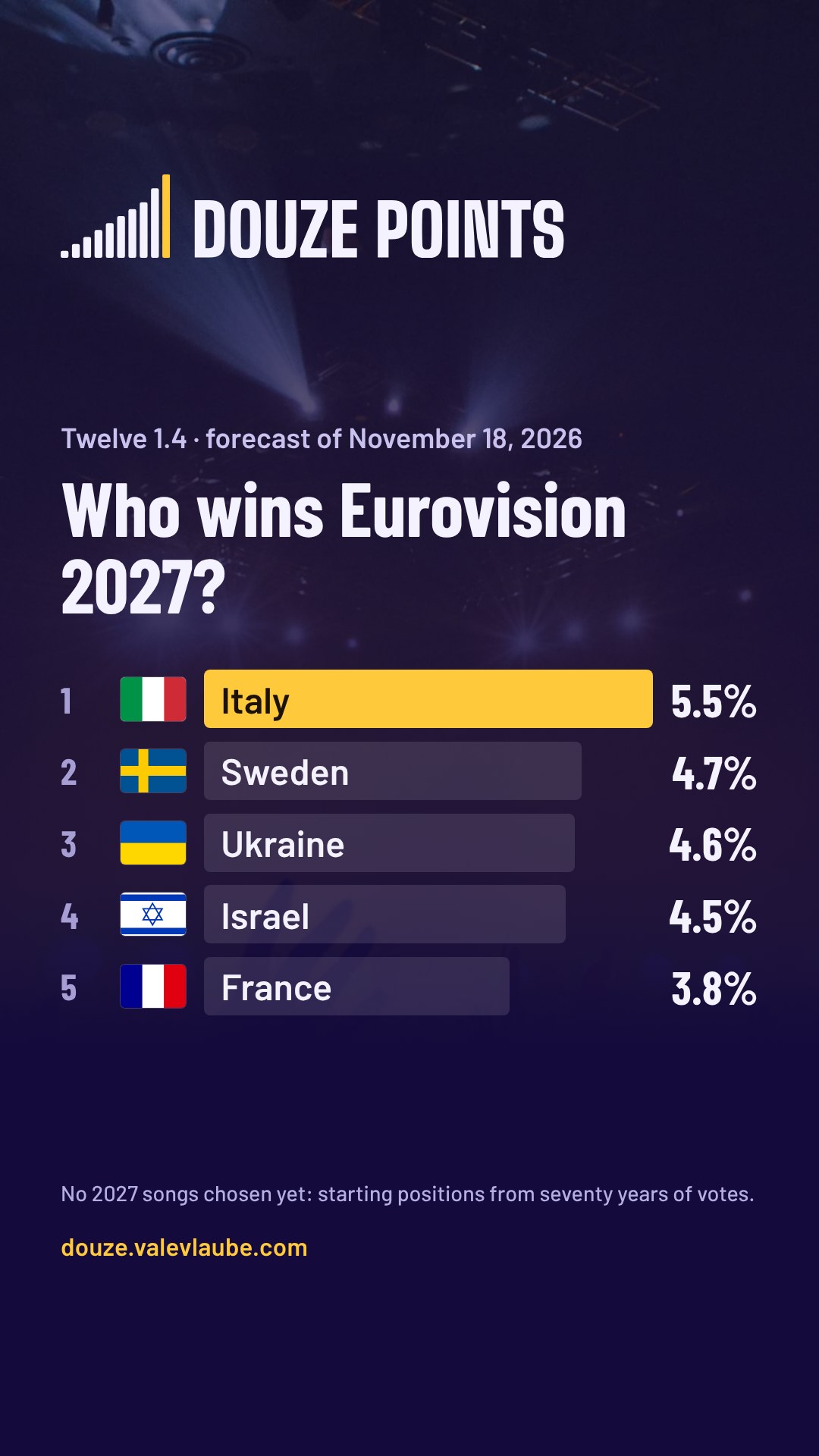
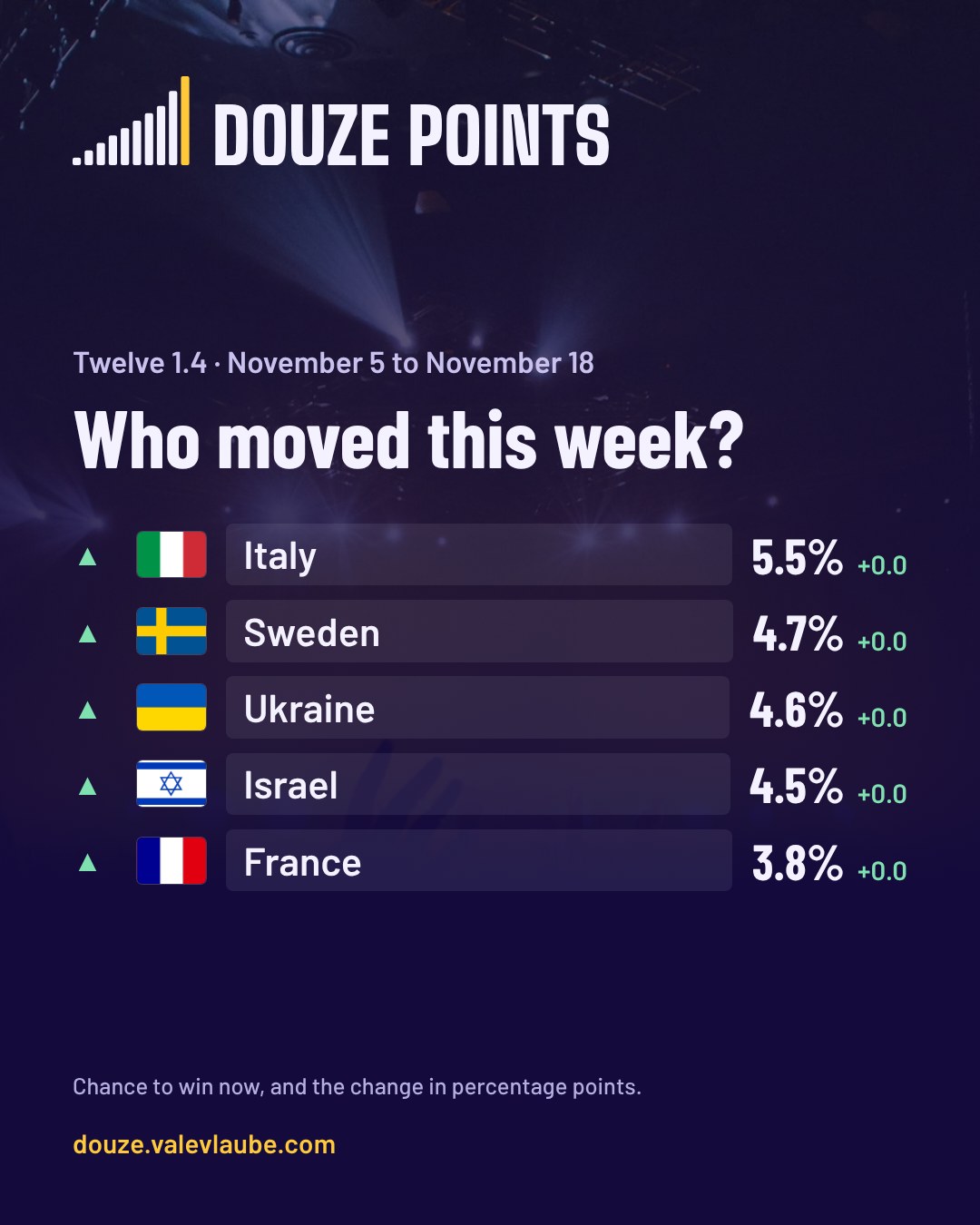
Every logo, icon and one-pager, plus a social media kit: profile images, covers for X, Facebook, LinkedIn and YouTube, and post and story cards with the current top five and the week's biggest movers.
- Download the brand kit (ZIP)Under 1 MB. Cards are redrawn with every forecast update.
- Post cardStory cardMovers cardProfile image

Boilerplate
Copy you can use
Free to quote, reprint and adapt with the credit “Douze Points by Valev Laube (douze.valevlaube.com)”. No permission needed.
In 40 words
Douze Points is an independent forecast of the Eurovision Song Contest 2027 in Burgas. Its model, Twelve, replays the contest 10,000 times using every jury and public vote since 1957, and updates as songs and odds arrive.
In 120 words
Douze Points is an unofficial, independent forecast of the Eurovision Song Contest 2027 in Burgas, Bulgaria, made by Estonian designer Valev Laube. Its model, Twelve, plays the whole contest 10,000 times: both semi-finals and the final, with a ranking from every jury and every public and twelve-to-one points from each. It draws on every vote cast since 1957, each country's recent results and how countries have voted for one another, juries and public separately. Before the songs are chosen, the numbers are wide on purpose. As each country picks its entry and the betting market prices it, the forecast tightens. Every change is logged, every past forecast is saved, and all of the data is free to download and reuse.
Three facts to quote
- Twelve has read every jury and public vote in the contest since 1957.
- Replayed on nine past finals, it named 5 of the 9 winners. The bookmakers' favorite named 4 or 5.
- Host countries finished 6.5 places below what their voting history predicted, on average across nine replayed finals.
Images
Free to use with the credit “Douze Points by Valev Laube (douze.valevlaube.com)”. Any country's own card can be saved from the voting map on the forecast page.
How it works
Twelve, the model, plays the whole contest thousands of times: both semi-finals, a ranking from every jury and every public, and twelve-to-one points from each. Each country's chance is the share of runs it wins.
It combines three things: how strong an entry is expected to be (recent form now, the songs and betting markets later), how each country has voted for every other since 2004, juries and public separately, and a large dose of chance for how a song lands on the night.
Douze Points is not affiliated with the EBU or the Eurovision Song Contest. Voting data: Eurovisionworld and the open Eurovision dataset (Spijkervet et al.).
Interviews and data requests
Built by Valev Laube, a designer and AI strategist who moved back to Estonia after 14 years in New York. Happy to talk about the forecast, run custom numbers for a country or provide data for a story.